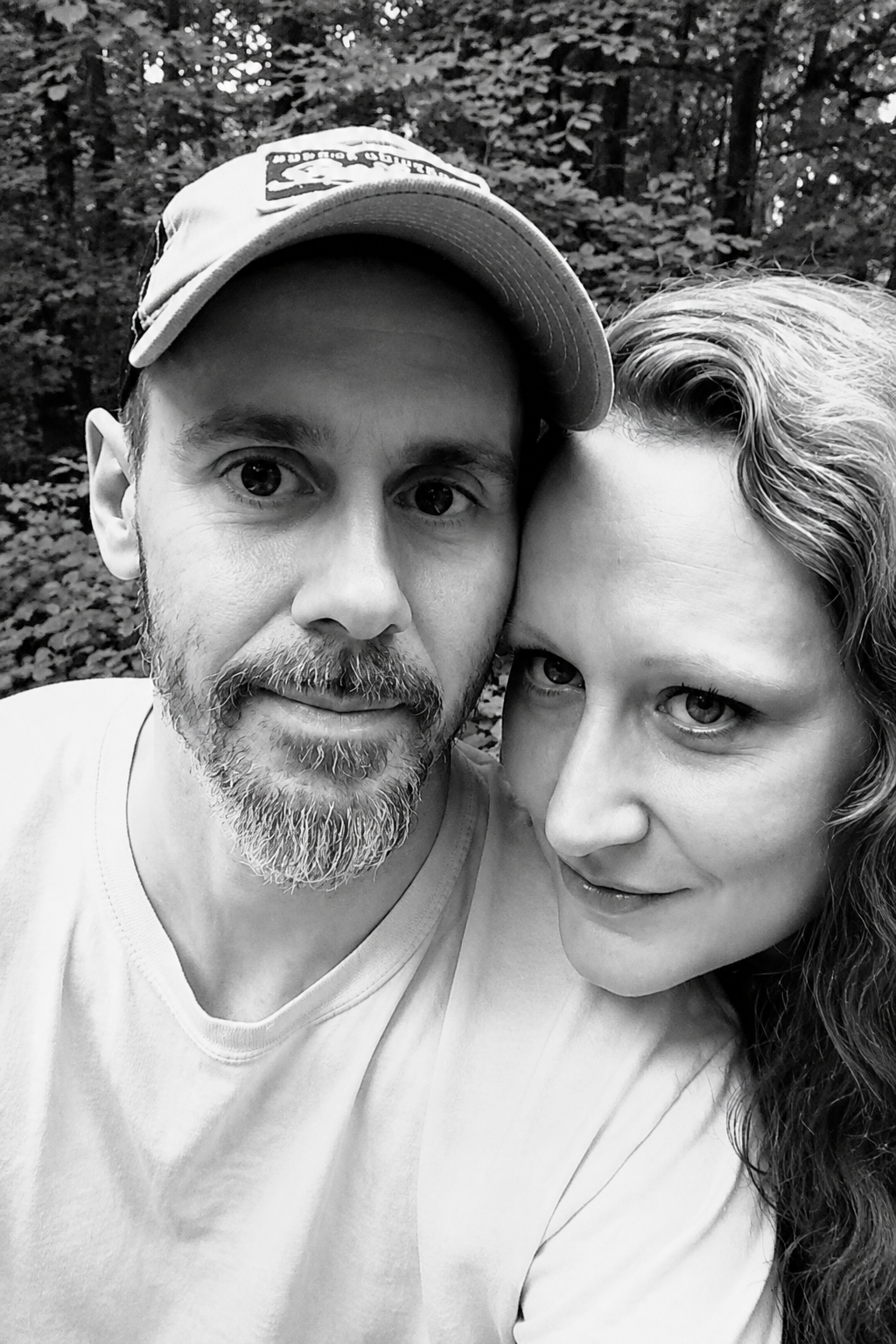
About The Founders
The Weight and the Dark
For as long as I can remember, both Jamie and I have lived under the suffocating weight of severe, unrelenting depression. It’s a thief that steals the color from the world and tells you you're entirely alone. It dragged us down into the absolute darkest corners a human mind can inhabit—pushing Jamie and me through suicide attempts where the noise became too loud, the air too thin, and we nearly didn't make it back to the light.
Jamie’s story is one of unimaginable survival. Long before we found each other, she endured a childhood carved out by abuse—physical and mental torment at the hands of the people who were supposed to protect her, compounded by a horrific assault at fourteen by a man meant to teach her. Yet, looking at her today, what defines Jamie isn't what happened to her; it’s the fierce, unyielding grace she forged in the fire.
The Anchor
How did we pull ourselves back?
In the middle of that suffocating silence, music became my tether. The raw, guttural truth of the blues gave voice to a pain I couldn't speak aloud. Just placing that needle on a record was sometimes the only thing anchoring me to the earth, whispering that suffering could somehow be an alchemist into something beautiful, enduring, and real.
Jamie is my muse, my anchor, and the absolute reason I am breathing right now. She is a horse trainer with a soul stitched to the wild—someone who speaks fluent horse and carries an intuitive, bone-deep wisdom born from working alongside nature and surviving her own profound trauma. She understands the language of healing in a way few ever do. She is also the brilliant mind behind our creative work, the one who knows how to turn a quiet whisper into a roar. Through every heavy, shadow-drenched day, she held up the mirror and told me my voice mattered.
A Testament to Survival
This blog isn’t just a collection of thoughts or recipes. It is a testament to survival. It is a promise we made to live deliberately, to love fiercely, and to build something that outlasts the dark. Whether you’ve wandered in here looking for a reflection on history, a comforting meal, or a quiet story from the pasture, we are so glad you found us.
Because we know what it means to stand on the edge of the abyss, giving back is not an afterthought—it is our heartbeat. We donate 25% of everything we earn through this work to The Jed Foundation, The Trevor Project, and the National Alliance on Mental Illness (NAMI). Suicide prevention, youth mental health, and holding space for families navigating these jagged roads are not abstract causes to us; they are deeply personal.
Thank you for reading, " Come as you are, listen awhile, stay forever."
Editorial Standards
WHY THIS PAGE EXISTS
Dopamine Blues writes about suicide, mental illness, addiction, and grief—and about the musicians and industry people who lived with them.
That writing can do really good. It can also do real harm. How a story about suicide is told measurably affects whether other people at risk seek help or attempt it. That is not a matter of opinion; it is the conclusion of decades of research, and it is why organizations like Samaritans and the American Foundation for Suicide Prevention publish detailed guidance for anyone writing about these subjects.
We follow that guidance. This page sets out exactly what that means, so you can judge our work against a stated standard rather than taking our word for it.
OUR LANGUAGE
Words carry assumptions. These are ours, and we hold to them even when it makes a sentence harder to write.
We write: died by suicide, took their life.
We don't write "committed suicide
Why: “Committed” belongs to an era when suicide was a crime and a sin.
We write: attempted suicide, made an attempt
We don't write "successful," "unsuccessful," or "failed attempt
Why: There is no success in a suicide, and survival is never a failure.
We write: living with depression, a person with bipolar disorder
We don't write "a depressive" or "a schizophrenic
Why: A condition is not an identity, and it is not all a person is?
We write: died of an overdose
We don't write: drug addict, junkie
Why: Person-first, always.
We write: died by suicide (specific)
We don't write "passed away" or "ended it
Why: Euphemism hides the subject from people who need to recognize it.
We also avoid calling any group “victims” of a condition. Shawn was not a victim of Ewing's sarcoma; he died of it, and he was a person before he was a patient.
WHAT WE NEVER PUBLISH
1. Methods, lethal means, or locations.
We do not describe how someone died, what they used, or where. This is the single most important rule on this page. Research consistently links detailed method reporting to increases in deaths by the same method. If a detail could function as instructions, it does not appear in our writing.
2. Single-cause explanations.
We will never write that someone took their life “because of” a tour, a break-up, a bankruptcy, or an album. No death has one reason. The best available understanding is a combination of risk factors, often including a treatable mental health condition.
3. Anything that romanticises.
No framing of death as noble, inevitable, a release, or the price of genius. No, “heaven gained another angel.” No suggestion that the world is better for it or that the art justified the cost. This is the failure mode we are most alert to, because music writing invites it constantly.
4. Diagnosis speculation about living people.
We do not diagnose anyone. If a living artist has not spoken publicly about a condition, we do not attribute one to them, imply one, or invite readers to guess. This is an ethical line we hold regardless of whether anyone sues us over it—and it is also a legal one.
5. Graphic descriptions, and material that can be used as a method.
If a description would distress a reader who is currently struggling, it does not go in.
6. Anything that points readers toward pro-suicide or pro-self-harm content.
Samaritans publishes specific guidance on this. We never link to, name, or gesture at forums or sites that promote or normalize suicide or self-harm, however critically we might be discussing them.
HOW WE WRITE ABOUT MUSICIANS
We write about what people said themselves. Public statements, interviews, lyrics, documented accounts — things the person put into the world. Not inference from how their art sounds.
We don't confuse the art with the illness. See below.
We don't use someone's worst moment as their biography. Their life is not a preface to their death.
We tell the whole arc where we can. Not only the pain. How someone got through, what helped, what they built afterwards. People who are struggling need to see the part after the crisis, because that is the part that shows them survival is possible.
THE "TORTURED GENIUS" MYTH
There is a persistent idea in music writing that mental illness produces great art, and that treating it would have dulled the work.
It is weak science, and it is harmful. It frames illness as identity, treatment as a threat, and suffering as a fair price for beauty. It also does nothing for the person who is not famous, not productive, and not making anything from their pain.
We will write about this myth directly in our Critique section, and we will not reproduce it accidentally in the way we cover anyone's life.
HIGH-PROFILE AND CELEBRITY DEATHS
This is the category where we are most careful, and it is where we deliberately do less.
Fans identify with artists. Identification is what makes music matter, and it is also what makes contagion more likely—which is why Samaritans publishes separate guidance for reporting celebrity and high-profile deaths.
So when we cover one:
- We cover it once, and we do not return to it repeatedly
- We give it ordinary placement, not a splash, not a lead, not a homepage takeover.
- We do not open comments on the piece
- We do not link back to our earlier coverage of the same death
- We do not reconstruct the final hours
- We keep the person's life in the story, not just the ending
The instinct in music writing is to go big on these. We go small, on purpose.
SELF-HARM
Self-harm is not a failed suicide attempt, and it is not attention-seeking. We do not describe methods, and we do not publish images of injuries.
CRISIS RESOURCES, EVERYWHERE THEY'RE NEEDED
Every article that touches suicide or self-harm carries crisis resources in its footer—not only our Resources page. The full list is here: [Crisis Resources].
Here is the standard footer we attach:
Text 988 for immediate help, or text HOME to 741741.
If you are in crisis, or you're worried about someone who is, please refer to our [Crisis Resources] page. You don't have to be in immediate danger to reach out, and you don't have to explain yourself first.
If you are in immediate danger, contact your local emergency number.
WHEN WE GET IT WRONG
We will get things wrong. When we do:
- We correct the piece and note what changed, rather than quietly editing
- If we published a detail we shouldn't have, we remove it and say that we removed it
- If a correction concerns a living person, we contact them first where we can
- We log the correction publicly. Trust is worth more than looking infallible.
If you think we've broken any of the standards on this page, tell us. That is a legitimate use of our contact page, and we would rather hear it from you than not at all.
OUR SOURCES
This page is built on published guidance from:
- Samaritans—media guidelines for reporting suicide, including dedicated guidance for celebrity and high-profile deaths, self-harm content online, and assisted dying
- American Foundation for Suicide Prevention (AFSP) — ethical reporting guidelines for media, and the Reporting on Suicide recommendations developed with other suicide prevention organizations
- World Health Organization — Preventing Suicide: A Resource for media professionals
Where our standards are stricter than the baseline, that is a deliberate choice and not an accident.
Last reviewed: September 18, 2026. We recheck this page and the numbers on it at least twice a year. If you spot something out of date, tell us.