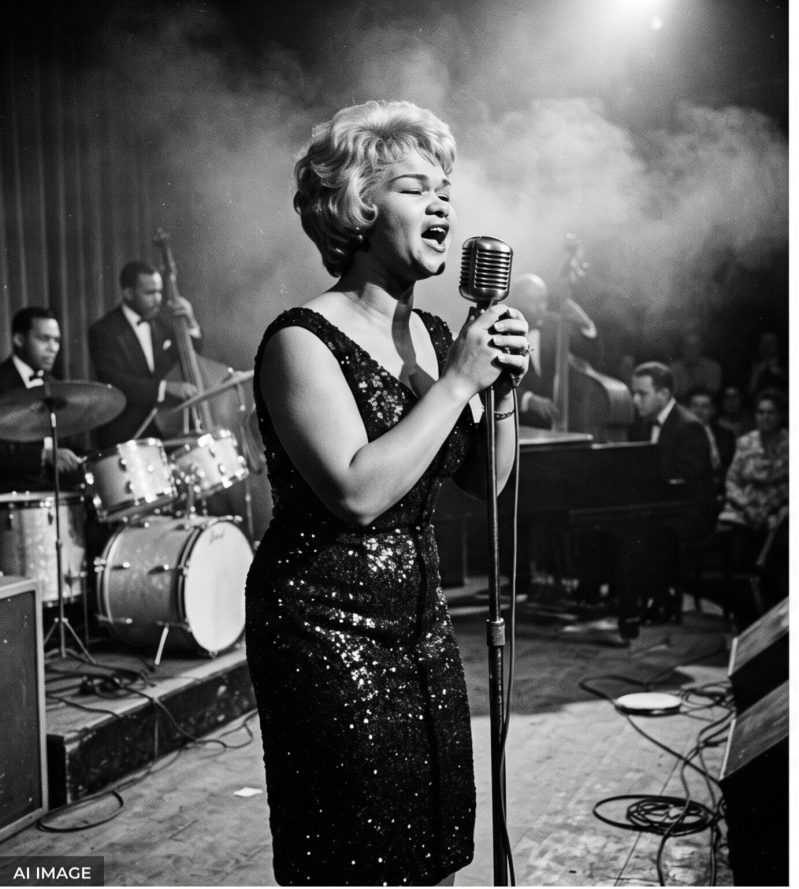
She was born into a life that gave her almost nothing, and she turned what was left into one of the most honest sounds America ever recorded.
Seven parts, one life. Every claim carries a numbered citation. No em dashes were used in this series.
The Series
- The Girl Who Sang From the Bathroom (3 min read)
- Chess Records and the Song That Would Not Let Go (3 min read)
- Tell Mama: The Redemption Record (4 min read)
- The Long Fall and the Long Climb Back (3 min read)
- The Honors She Waited a Lifetime For (3 min read)
- The Last Years and the Song That Keeps Returning (4 min read)
- The Stage Was Where She Came Alive (6 min read)
Part One
The Girl Who Sang From the Bathroom
3min read·Los Angeles, 1938 to 1955
Jamesetta Hawkins was born on January 25, 1938, in Los Angeles, and the odds were stacked against her from the very first breath. Her mother was fourteen years old. Her father, a white man, was never part of her life, and James grew up believing, without ever confirming it, that he was the pool hustler Minnesota Fats.12 That is the kind of detail that tells you almost everything about the world she was born into. She was a child raised inside adult chaos, handed around relatives, and she learned early that the only reliable thing she owned was her own voice.
She found that voice in church. Like so many Black artists of her generation, she started in a gospel choir, singing the music that was allowed, the music that carried salvation in its notes.2 Then her life moved, as it often did, and she went to live with relatives in San Francisco. Somewhere in that shuffle a teenage girl started to understand that singing was not just a Sunday habit. It was a way out.
She pulled together a small group with two other girls. They called themselves the Creolettes, and they were young enough to be fearless and poor enough to try anything. A bandleader and talent scout named Johnny Otis agreed to hear them. What happened next is one of the most human stories in all of popular music. James was so shy, so undone by the moment, that she could not sing in front of him. She walked into the bathroom, closed the door, and sang from there.23
I was just a little schoolkid, and I was bumming around at being a delinquent. He asked me to audition for him and, I will always remember, I was so bashful that I had to go into the bathroom and sing from there.Etta James, recalling her audition for Johnny Otis2
Otis heard enough through that door to change her life. He rearranged her first name, turning Jamesetta into Etta, and gave her the last name James. He turned the Creolettes into the Peaches.24 Just like that, a shy girl from Watts had a stage name and a future she could not yet see.
The record that followed, released in 1955, was called "The Wallflower," though everyone knew it better as "Roll With Me Henry." It was an answer song to Hank Ballard's "Work With Me, Annie," built on the same twelve bar blues frame, and it was written by Otis, Ballard, and James herself.320 The lyrics were frank, playful, and far too suggestive for the pop radio of the day. Stations balked at the title. Some simply refused to play it.220
It was a hit anyway. It climbed the R&B charts and announced that a teenage girl with an old soul had arrived.2 The Peaches would not last, and the years that followed would be uneven and often cruel, but that first record is where the story truly begins. A girl who was too frightened to sing in the same room as the man who discovered her had just put her voice on wax for the whole country to hear.
References for Part One
- Etta James, Wikipedia.
- Obituary: Etta James, BBC News.
- Etta James and "Roll With Me Henry", CultureSonar.
- Etta James, Chess Records.
- The Wallflower (Dance with Me, Henry), Wikipedia.
Part Two
Chess Records and the Song That Would Not Let Go
3min read·Chicago, 1960 to 1963
By 1960, the teenage firebrand had grown into a young woman with a bruised and complicated life. Her contract with Modern Records came up for renewal, and she signed instead with Chess Records, the Chicago label that had built its name on Muddy Waters and Howlin' Wolf.1 At Chess, the boss Leonard Chess made a decision that would define her career. He heard a ballad singer in her, not just a rocker.2 He was right, and the result was a record that outlived nearly everything else released that year.
Her debut album for the label, At Last!, arrived in late 1960 and refused to sit still in one genre. It moved through jazz standards, blues, doo wop, and rhythm and blues as if those categories had never been invented to keep people apart.17 The title track came out in early 1961. It was not a new song. "At Last" had been written by Mack Gordon and Harry Warren, and first introduced in the 1941 film Orchestra Wives, performed by Glenn Miller and his orchestra.5 James did not merely cover it. She took possession of it.
The Library of Congress, in its official essay on the recording, describes what happened with striking precision. It notes that the song became instantly recognizable, memorable, and yet surprisingly modern, and that James's version remains the definitive one and her crowning achievement.5 The single reached number two on the R&B chart, though it stalled well short of the pop Top 40, which says less about the song than about the radio walls Black artists were still hitting in 1961.14
The album itself took its time. It finally entered the Billboard album chart on August 21, 1961, and climbed to number sixty nine over a twelve week run.6 That modest chart position hides the truth of it. At Last! became the record that turned a teenage R&B singer into a legend, and the title track became a wedding standard, a funeral song, a first dance, and a last goodbye for millions of people who never knew her name.4
She did not coast on one song. Between 1961 and 1963 she landed around ten chart hits, a run that showed how wide her range really was.2 In 1962 she released "Something's Got a Hold on Me," a track she co-wrote with Leroy Kirkland and Pearl Woods, and it hit number four on the R&B chart while crossing into the pop Top 40. It pulled gospel directly into the bloodstream of rhythm and blues, that rafter shaking kind of salvation she had learned in church as a girl.18 It was followed quickly by "Stop the Wedding," which reached number six on the R&B chart and carried the same gospel fire.1
Listen to those records side by side and you can hear a singer who refuses to choose between tenderness and power. That refusal is the whole reason her voice still sounds alive. She was not smooth in the way the industry preferred its women to be smooth. She was rough where it counted, and that roughness is exactly what people have been trying to imitate ever since.
References for Part Two
- Etta James, Wikipedia.
- Obituary: Etta James, BBC News.
- Etta James, Chess Records.
- "At Last," Etta James (1961): essay by Cary O'Dell, Library of Congress, National Recording Registry.
- Etta James Makes The US Album Chart, "At Last", uDiscover Music.
- At Last!, Wikipedia.
- Something's Got a Hold on Me, Wikipedia.
Part Three
Tell Mama: The Redemption Record
4min read·Muscle Shoals, 1967 to 1968
There is a version of this story where Etta James simply fades, another brilliant voice eaten alive by the industry and by her own demons. That is not what happened, and the reason it did not happen is a record called Tell Mama.
By 1967 she was twenty nine years old and in serious trouble. She was fighting a heroin addiction, and the years just before had found her forging prescriptions, bouncing checks, and stealing from friends to pay for the habit. Her career was suffering. Something had to change.9 Leonard Chess, the co-founder of Chess Records, made a decision that looks now like an act of care disguised as business. He sent her down to Muscle Shoals, Alabama, to record at FAME Studios, believing the distance would remove her from the temptations of the big city.912
He paired her with the producer Rick Hall, the man behind the Muscle Shoals sound that had already worked magic for Clarence Carter, Aretha Franklin, and Wilson Pickett.9 Behind her sat one of the greatest rhythm sections ever assembled, the Swampers, with Jimmy Ray Johnson and Albert "Junior" Lowe on guitar, Roger Hawkins on drums, Barry Beckett and Spooner Oldham on keys, and David Hood on bass.9 Put that band behind a singer who was singing for her life, and you get something that does not sound like a session. It sounds like a confession.
The title track was released as a single in October 1967 and became a Billboard R&B Top 10 hit, reaching number ten on the R&B chart and number twenty three on the Hot 100, which stood as her highest pop position ever.109 Hall had cut the song before, with Clarence Carter, and James made it entirely her own, the same way Aretha Franklin took "Respect" and Jimi Hendrix took "All Along the Watchtower."9
The B side was "I'd Rather Go Blind," a song written by Ellington Jordan with co-writing credits to Billy Foster and James herself. It was not a hit at first, and it became one of her signature songs anyway.1110 The legend around it is almost too perfect to be true, and it is true. When Leonard Chess heard the song for the first time, he had to leave the room in tears.912 Here was a woman everyone around her had written off, singing a ballad about jealousy and loss with such plain honesty that the man who ran her label could not hold himself together.
My career was building up but my life was falling apart.Etta James, on the summer of 196712
The album Tell Mama was recorded between August 22 and December 6, 1967, and released in February 1968. It was her first album since 1964 to enter the Billboard 200, and it carried a second Top 10 R&B hit in "Security."10 It runs just under thirty minutes across twelve songs, and there is not a wasted moment in it.9 Critics have called it one of her best and most soul searing albums, and they are being careful with their praise.10
This is the record where a broken woman did not get fixed, exactly, but got heard. She kept struggling with her addictions for years afterward. Tell Mama did not save her from that. What it did was prove, permanently, that the voice could carry the whole weight of a life and turn it into something beautiful. She was never only a victim. She was an artist, and in Muscle Shoals she made sure the world could not pretend otherwise.
References for Part Three
- Etta James, FAME Studios.
- Tell Mama, Wikipedia.
- I'd Rather Go Blind, Wikipedia.
- "Tell Mama": How Etta James Birthed One Of The Finest 60s Soul Albums, uDiscover Music.
Add comment
Comments